
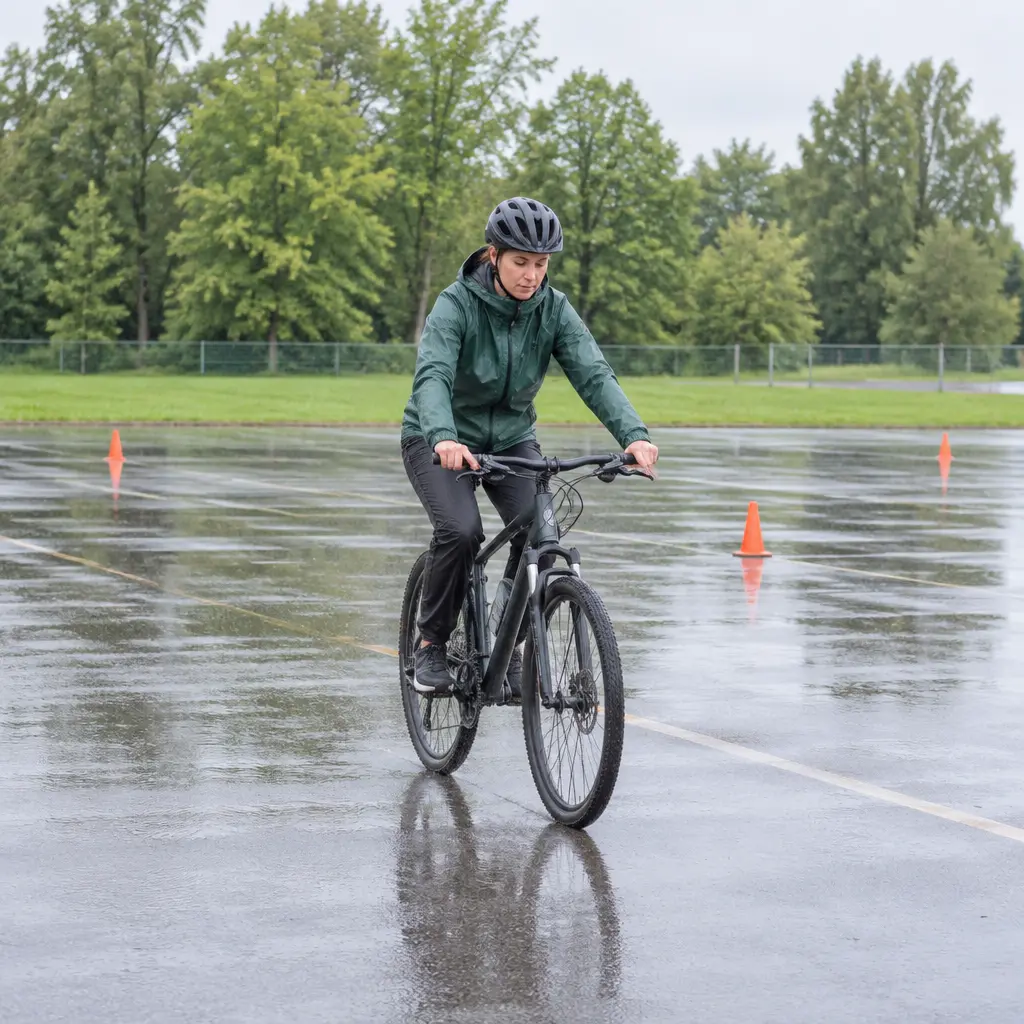
Brake modulation confidence in wet conditions is a rider’s demonstrated ability to apply, adjust, and release braking force smoothly and predictably on a damp or slippery surface. A test-ride evaluation should assess that confidence through controlled, repeatable observations—not a single hard stop—because wet grip depends on surface, tires, speed, brake setup, and rider technique. This protocol defines the evaluation, separates its main components, and outlines a safe test sequence, scoring method, and reporting approach. The need is practical: the World Health Organization reports that road crashes cause about 1.19 million deaths annually worldwide, while the U.S. Federal Highway Administration identifies wet pavement as a factor in roughly three-quarters of weather-related crashes in the United States. Those figures do not measure brake confidence directly, but they underscore why wet-condition control deserves systematic assessment.
Evaluating Brake Modulation Confidence in Wet Conditions
Brake modulation is the controlled adjustment of braking force to achieve the required deceleration without abrupt lockup, loss of balance, or unintended changes in direction. Confidence, for evaluation purposes, is not simply a rider’s stated comfort: it is the combination of perceived control and observable, repeatable performance. This protocol applies to bicycles and motorcycles, but the test must be adapted to the vehicle, its braking system, and the manufacturer’s instructions. It is a structured riding assessment, not a substitute for professional instruction or a controlled laboratory test.
Wet surfaces reduce or vary available tire grip, and painted markings, metal covers, oil, leaves, standing water, and different pavement textures can make traction especially inconsistent. The National Highway Traffic Safety Administration advises motorcyclists to increase following distance and use smooth inputs in poor conditions; bicycle safety guidance similarly emphasizes controlled braking and avoiding abrupt maneuvers. A useful evaluation therefore records surface and conditions, standardizes the test as far as practical, and treats any skid, instability, or loss of control as a safety signal—not as a challenge to repeat.
Defining the Test-Ride Brake Modulation Confidence Protocol
The protocol is a planned sequence of low-risk riding tasks used to observe how a rider applies and regulates braking on a verified, consistently wet surface. It combines vehicle inspection, rider readiness, progressive braking exercises, structured observations, and a clear stop rule. No universal standard establishes a single wet-braking confidence score for all bicycles and motorcycles; results should therefore be reported with the test conditions and scoring criteria, rather than presented as a certified safety rating.
The core attributes are smoothness of force application, ability to maintain balance and direction, appropriate front-to-rear brake use, controlled release, and the rider’s ability to explain what they felt. Related assessment categories—or hyponyms of the broader protocol—include straight-line progressive braking, speed reduction before a turn, front/rear brake coordination, low-speed control, and post-stop confidence reporting. These categories are related, but they are not interchangeable: strong performance in a straight line does not prove safe braking while cornering.
Operational Definition and Scope
For this protocol, “confidence” means the rider can produce a requested, moderate reduction in speed with deliberate brake input while maintaining stability, and can identify whether the response felt predictable. The definition deliberately combines observed behavior with self-report. A rider may feel confident yet brake abruptly, or may perform smoothly while reporting uncertainty; either result matters and should be recorded separately.
The test evaluates the rider–vehicle–surface interaction, not the rider alone. Tire condition and pressure, brake adjustment, tire type, suspension, vehicle load, anti-lock braking system (ABS) operation where fitted, and surface contamination can all affect the result. The National Highway Traffic Safety Administration describes ABS as a system intended to help prevent wheel lock during braking, but ABS does not remove the need for appropriate speed, traction, and smooth control. Do not disable safety systems for a confidence test.
Wet-Surface and Environmental Conditions
A suitable test area is closed to public traffic, level, spacious, and free of hazards, with a predictable surface and a runoff area. Record whether the surface is uniformly damp, freshly wet, or drying; note temperature, visible contamination, slope, and any standing water. Do not deliberately introduce oil, soap, or other low-friction substances. Avoid testing on public roads, in heavy rain, near traffic, or on surfaces where a fall would expose the rider to vehicles or hard obstacles.
The Federal Highway Administration’s weather-related crash analyses show that wet pavement is a frequent contributor to U.S. weather-associated crashes, but this broad statistic cannot predict grip at a particular test site. Surface condition should be described directly rather than inferred from the word “wet.” A simple site sketch or photo log can help document the test lane, braking zone, and any surface changes; do not use an image or a single measurement as proof that grip is uniform.
Preparing the Rider, Vehicle, and Test Area
Preparation establishes whether an observed difficulty is related to braking technique or to an avoidable equipment or site problem. Before riding, the evaluator should explain the sequence, agree on a stop signal, confirm protective equipment, and check that the rider understands the test is not a competition. The rider should be rested, sober, appropriately licensed or trained for the vehicle, and comfortable with its controls.
Vehicle and Brake Inspection
Inspect tires for adequate tread, damage, and correct inflation; check brake operation, lever or pedal travel, pad condition, and any warning indicators. For bicycles, confirm that wheels are secure and brakes are correctly adjusted; for motorcycles, follow the owner’s manual and applicable inspection procedures. Do not conduct the test if the brakes feel inconsistent, a tire is damaged, or a warning light indicates a system fault. Record relevant details such as vehicle type, brake configuration, tire model if known, load, and ABS status.
Rider Briefing and Baseline
Ask the rider to rate anticipated confidence on a consistent scale, such as 1 to 5, where 1 means “not confident” and 5 means “very confident.” Explain that this is a subjective measure, not a pass mark. Establish a low-speed baseline on a dry or higher-grip area if available, then review the vehicle’s braking controls and the intended stopping zone. The evaluator should demonstrate the task only if qualified and able to do so safely.
Conducting the Wet Braking Evaluation
The assessment should progress from familiarization to controlled braking, with speed and task difficulty increased only when the rider remains stable and the surface remains suitable. Use a marked approach lane and stopping zone. Keep each run comparable, but allow adequate recovery time and do not ask the rider to repeat a maneuver after a skid, panic response, or loss of control. Where possible, an independent observer should record behavior from a safe position outside the riding line.
Stage One: Familiarization and Gentle Deceleration
Begin at walking pace or another suitably low speed for the vehicle and site. Ask the rider to apply the brakes gently, reduce speed, and release smoothly while travelling straight. Observe whether the rider looks ahead, keeps a stable posture, and avoids grabbing the controls. The goal is to confirm basic familiarity and identify obvious equipment or surface concerns, not to measure maximum stopping performance.
Stage Two: Progressive Straight-Line Braking
If the first stage is controlled, proceed with several moderate, straight-line decelerations from a pre-agreed low speed. The rider should build braking force progressively and stop within the designated zone without abrupt steering. Record the approach speed if a reliable method is available; otherwise, describe the speed category consistently rather than inventing precision. Note brake application smoothness, stability, wheel behavior, stopping-zone control, and whether the rider can repeat the maneuver without escalating tension.
For motorcycles, assess coordinated use of the controls according to the rider’s training and the manufacturer’s guidance; do not impose a universal front-to-rear braking ratio. For bicycles, observe whether the rider uses both brakes appropriately for the bicycle and conditions, without an abrupt front-brake input or uncontrolled rear-wheel skid. If ABS activates, record the event and whether the rider maintains control; do not treat system intervention alone as failure.
Stage Three: Controlled Speed Adjustment Before a Turn
Only after stable straight-line performance, assess whether the rider can reduce speed before entering a broad, low-speed turn. The purpose is to observe timing and smooth release—not to test emergency cornering or braking while leaned over. The rider should complete most deceleration before the turn, then maintain a predictable line. Stop this stage if the surface is uneven, the turn cannot be made with generous clearance, or the rider shows uncertainty.
Stage Four: Rider Reflection and Repeatability
After each stage, ask the rider what the brakes felt like, whether the vehicle responded as expected, and what they would change. Re-rate confidence using the same scale as the baseline. A rising score is not automatically evidence of improved control; compare it with observed smoothness, stability, and consistency. If subjective confidence rises while control remains abrupt or unpredictable, prioritize coaching and do not progress to higher speeds.
Scoring, Interpretation, and Validation
A transparent rubric makes observations easier to compare, but it does not turn a field test into a validated clinical or engineering instrument. Rate each domain as 1 (needs intervention), 2 (inconsistent), or 3 (controlled), and include notes. Assess smooth application, straight-line stability, appropriate brake coordination, controlled release, repeatability, and rider-reported confidence. Report the domain scores individually instead of relying on a single total that could conceal a serious weakness.
- Controlled application: force is built progressively, without an abrupt grab or panic squeeze.
- Stability and direction: the vehicle remains within the lane without unintended weave, skid, or loss of balance.
- Brake coordination: the rider uses the available controls appropriately for the vehicle and follows its operating guidance.
- Release and completion: braking is eased predictably, and the rider stops within the intended zone without an unsafe maneuver.
- Repeatability and reflection: the rider can explain the response and perform the low-speed task consistently.
A defensible evaluation also records test conditions and limitations. Include date, site, surface description, weather, vehicle and tire details, brake-system status, task sequence, approximate speed method, observer, deviations, and any stop-rule event. If comparing sessions, keep the vehicle, lane, approach speed, and surface condition as similar as possible. Differences in rain intensity, contamination, temperature, or tire state can make apparent improvement misleading.
The Centers for Disease Control and Prevention’s general injury-prevention guidance emphasizes that safety depends on multiple interacting factors; likewise, a field score should not be interpreted as a guarantee of real-world stopping distance. Stopping distance varies with initial speed, reaction time, slope, tire–surface friction, brake condition, and rider response. This protocol does not calculate a universal wet stopping distance, and no rider should be encouraged to approach the traction limit merely to generate a score.
Safety Limits, Stop Rules, and Common Errors
The evaluator must end the test immediately if the rider loses control, a wheel locks unexpectedly, the vehicle leaves the test lane, equipment behaves abnormally, visibility deteriorates, or another person enters the area. Also stop if the rider asks to stop, becomes distressed, or cannot follow the briefing. After any fall or suspected injury, do not resume the session; arrange appropriate assistance and inspect the vehicle before any later use.
Avoiding Unsafe or Misleading Test Design
Common errors include starting too fast, testing on a public road, using an unmarked or contaminated surface, changing multiple variables between runs, and treating maximum braking as the only meaningful result. Another error is equating confidence with competence. A rider’s self-report is valuable, but it should be interpreted alongside observable performance and equipment condition. Do not publish a result as a pass/fail certification unless a recognized standard and qualified assessment process support that claim.
A useful text-based chart for a report is a run-by-run table with columns for stage, surface, speed category, application smoothness, stability, stopping-zone control, confidence rating, and notes. The chart should show trends and safety events without implying laboratory accuracy. For example, a rider who performs smooth low-speed stops but reports persistent uncertainty may benefit from supervised practice; a rider who reports high confidence but repeatedly skids should not be advanced to more demanding tasks.
Conclusion: Applying the Brake Modulation Confidence Protocol
A sound wet-condition test-ride evaluation defines confidence through both rider feedback and observable control. It prepares the vehicle and site, progresses from gentle familiarization to moderate straight-line braking, assesses turn preparation only when appropriate, and uses a documented rubric with clear stop rules. Because there is no universal wet-confidence score, conclusions should remain specific to the rider, vehicle, surface, and tasks performed.
Wet-road crash data from the World Health Organization and Federal Highway Administration reinforces the broader importance of traction-aware riding, but it cannot replace careful local assessment. Use this protocol as a conservative training and observation framework, not as a limit test. Riders should review their vehicle’s manual, seek qualified instruction, maintain tires and brakes, and practice only in a controlled, low-risk setting.
Sources: World Health Organization, Road traffic injuries, https://www.who.int/news-room/fact-sheets/detail/road-traffic-injuries; Federal Highway Administration, How Do Weather Events Impact Roads?, https://ops.fhwa.dot.gov/weather/q1_roadimpact.htm; National Highway Traffic Safety Administration, Motorcycle Safety, https://www.nhtsa.gov/vehicle-safety/motorcycles; National Highway Traffic Safety Administration, Anti-lock Braking Systems (ABS), https://www.nhtsa.gov/equipment/anti-lock-braking-system-abs; Centers for Disease Control and Prevention, Injury Prevention and Control, https://www.cdc.gov/injury/.
